Air conditioning systems are engineered around airflow.
Heat transfer efficiency depends on stable, unrestricted air movement across the evaporator coil. When airflow remains consistent, refrigerant absorbs indoor heat effectively and the system operates within its designed pressure and temperature range.
When airflow becomes restricted, performance declines immediately — even if the system still appears to function normally.
One of the most underestimated causes of HVAC performance degradation is evaporator coil contamination.
The Engineering Role of the Evaporator Coil
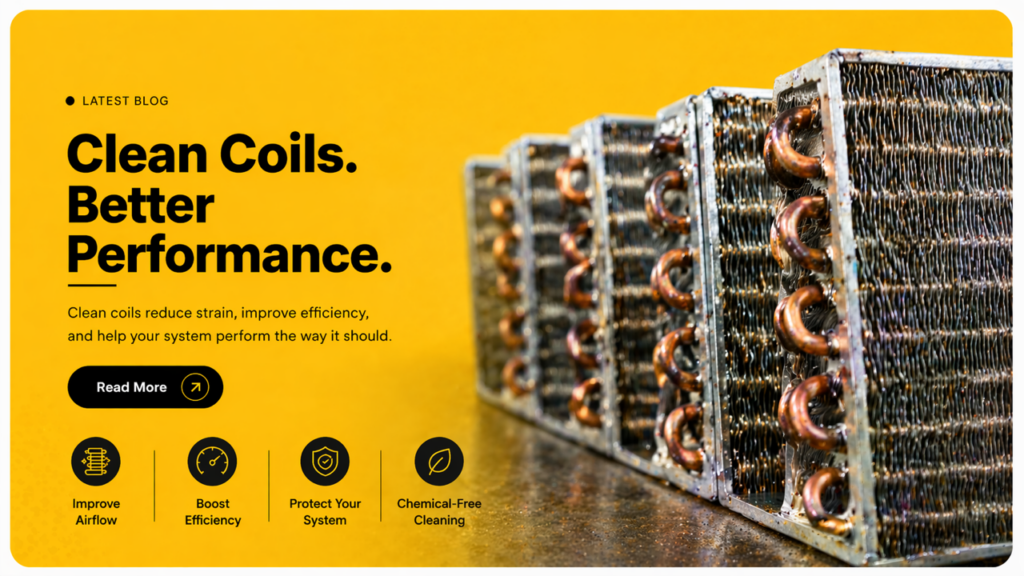
Evaporator coils are constructed with tightly spaced aluminum fins to maximize surface area. That surface area enables efficient thermal exchange between indoor air and the refrigerant circuit.
However, the same narrow fin channels that improve heat transfer also collect dust.
Over time, airborne particles accumulate between fin rows. As contamination builds:
• Airflow resistance increases
• Static pressure rises
• Heat transfer efficiency drops
• System runtime extends
• Electrical consumption increases
This efficiency loss rarely presents as system failure.
It presents as longer runtime.
Quantifying the Performance Loss
HVAC technical literature indicates that moderate evaporator coil fouling can reduce heat transfer efficiency by up to 15 percent.
To understand the impact, consider a residential system consuming 1,200 kWh per month during peak cooling season.
A 15 percent efficiency drop due to airflow restriction results in:
1,200 kWh × 15% = 180 kWh additional energy use
At $0.16 per kWh:
$28.80 per month in excess operating cost
Across an 8–9 month cooling season:
$230–$260 annually in avoidable energy waste
And this assumes moderate buildup.
Severe contamination amplifies system stress further.
Mechanical Consequences of Restricted Airflow
Airflow restriction is not cosmetic.
It is mechanical stress.
When airflow decreases:
• The compressor operates longer per cycle
• The blower motor works against higher static pressure
• Coil surface temperatures shift outside optimal range
• Risk of evaporator icing increases
• Internal mechanical load accumulates
The compressor is the most expensive component in a residential HVAC system. Extended runtime accelerates wear, increasing the probability of premature failure.
Efficiency loss is not just about energy cost.
It is about cumulative mechanical strain.
HVAC performance is not defined solely by SEER ratings.
It is defined by airflow integrity.
And airflow integrity begins at the coil.
Why Efficiency Loss Often Goes Unnoticed
Most performance degradation happens gradually.
The system still cools.
The thermostat still responds.
The unit still cycles.
But airflow becomes restricted.
Early indicators include:
• Extended cooling cycles
• Reduced airflow at vents
• Gradual rise in electricity usage
• Occasional coil icing
Because the system still “works,” contamination often remains unaddressed until performance drops significantly.
By then, mechanical stress has already accumulated.
Airflow Discipline Is System Discipline
Evaporator coil cleaning is not cosmetic maintenance.
It is mechanical correction.
Restoring airflow:
• Stabilizes system pressures
• Reduces runtime
• Lowers electrical demand
• Protects compressor longevity
• Maintains consistent cooling capacity
HVAC efficiency is not only about equipment specification.
It is about preserving airflow geometry.
And airflow geometry is preserved through disciplined coil maintenance.