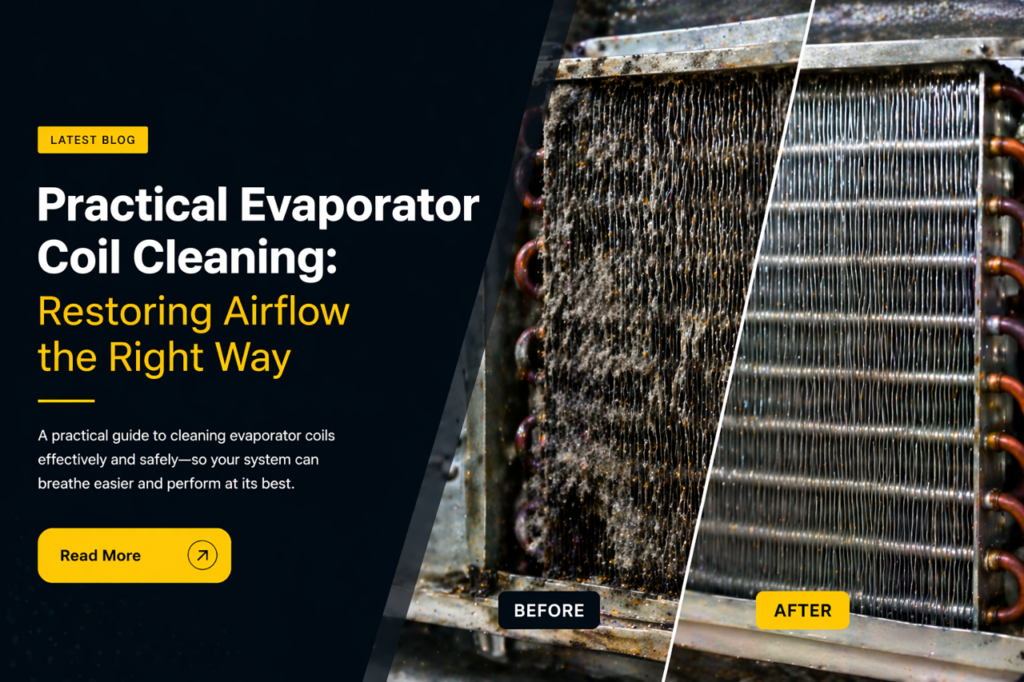
Most HVAC efficiency losses begin gradually.
The system continues operating, but airflow becomes restricted due to dust accumulation between evaporator coil fins.
As airflow drops, the system compensates by running longer to meet thermostat demand.
Common early signs include:
• Extended runtime
• Reduced vent airflow
• Rising electricity consumption
• Occasional indoor coil icing
Restoring airflow is not complex.
It is controlled mechanical cleaning.
Before You Begin
Evaporator coil cleaning does not involve refrigerant handling or pressure adjustments.
It requires:
• Turning off power to the air handler
• Removing the access panel
• Inspecting fin channels carefully
The objective is not cosmetic improvement.
The objective is airflow geometry restoration.
Proper Mechanical Cleaning Principles
Light to moderate contamination can often be removed using precise mechanical cleaning along the direction of the fins.
Critical precautions:
• Never scrape across fin rows
• Avoid high-pressure water inside the cabinet
• Do not bend aluminum fins
• Avoid improvised hardware tools
Improvised cleaning methods frequently cause more damage than contamination itself.
A purpose-built coil cleaning tool is engineered to:
• Follow fin geometry
• Apply controlled mechanical contact
• Remove debris without distortion
• Preserve fin alignment
Mechanical vs Chemical Cleaning
Chemical sprays may loosen surface debris.
However, physical removal between fin channels restores airflow more effectively during routine maintenance.
Mechanical cleaning is:
• Residue-free
• Controlled
• Suitable for indoor coils
• Appropriate for preventive maintenance
Chemical cleaning is typically reserved for:
• Grease-heavy environments
• Severe contamination
• Commercial applications
What Proper Cleaning Achieves
When airflow stabilizes:
• Runtime decreases
• Electrical consumption drops
• Mechanical strain reduces
• Cooling performance becomes consistent
Evaporator coil cleaning is not system modification.
It is controlled debris removal.
When done carefully, it is a disciplined maintenance task — not a technical overhaul.
Airflow discipline protects performance.
And performance protection begins at the coil.